
ArchSolutioNZ Building Consent Specialists
    Updated May 22, 202610 min readCoA and unconsented work

    Certificate of Acceptance in New Zealand: what homeowners need to know before dealing with unconsented work.

    A Certificate of Acceptance, often called a CoA, can help resolve certain building work completed without a building consent. It is not a retrospective consent, and it does not give full assurance for hidden work.
    Bottom line

    A Certificate of Acceptance gives limited council acceptance for certain completed work, not a full sign-off.

    Start by proving what was built, when it was built and how it meets the Building Code. The more work is hidden behind linings, foundations, waterproofing or services, the more evidence council will usually need and the more likely the certificate may include exclusions.

    Clear definition

    What is a Certificate of Acceptance?

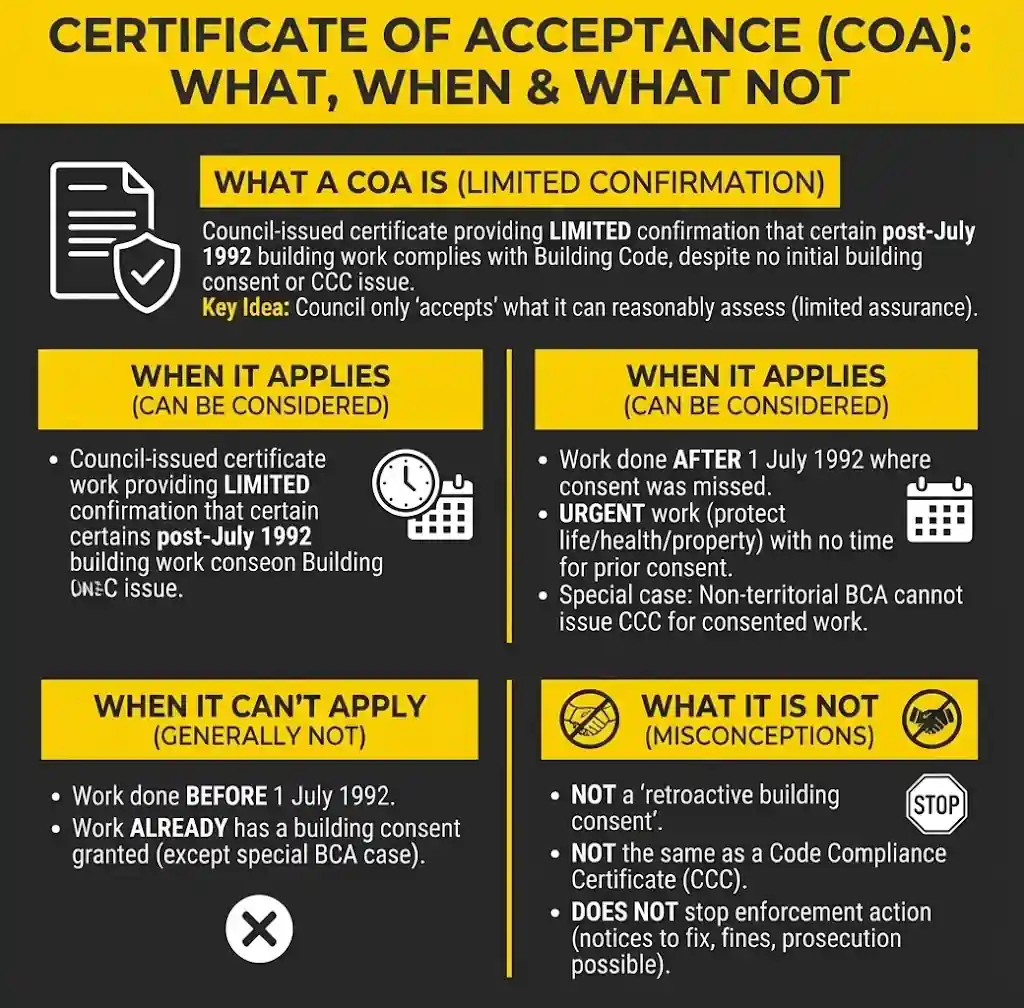
    A Certificate of Acceptance is a council-issued certificate for specific building work that was carried out without a building consent, or where a Code Compliance Certificate cannot be issued in limited situations. In most homeowner cases, it is used for unconsented work completed after 1 July 1992.

    It can also apply to urgent work carried out under section 42 of the Building Act 2004, or a limited specialist BCA scenario where a CCC cannot be issued.

    Key idea: council can only assess what it can reasonably see, test or verify after the work has already been completed.

    Certificate of Acceptance guide explaining what a CoA is, when it can apply and what it is not

    When a CoA can apply

    • Building work was carried out after 1 July 1992 and a building consent was required but not obtained.
    • Urgent building work was carried out to protect life, health or property and there was no time to get consent first.
    • An accredited building consent authority that is not a territorial or regional authority granted consent but is unable or refuses to issue a CCC.

    When a CoA will not solve it

    • Work was completed before 1 July 1992.
    • A building consent already covers the work, except for the limited non-territorial BCA scenario.
    • The problem is mainly a planning, title, cross-lease, resource consent or zoning issue rather than a Building Code acceptance issue.

    What a CoA is not

    Not a retrospective consent

    A building consent is normally issued before work starts, not after it is finished.

    Not the same as a CCC

    A Code Compliance Certificate confirms work complies with an issued consent. A CoA is more limited.

    Not immunity from enforcement

    Councils may still issue notices, require remedial work or take enforcement action.

    Council risk

    Why limited assurance matters

    Council did not inspect the work during construction. That means some elements may now be difficult, expensive or impossible to verify without opening up the building.

    Common problem areas include foundations, framing, structural connections, fire separations, waterproofing, plumbing, drainage, insulation and services hidden behind linings. If council cannot reasonably inspect or verify those elements, the CoA may be qualified or exclude parts of the work.

    Practical takeaway: the more closed-in the work is, the stronger your evidence needs to be. Photos, invoices, producer statements, specialist reports and accurate as-built drawings can make a major difference.

    Process map

    Typical Certificate of Acceptance process

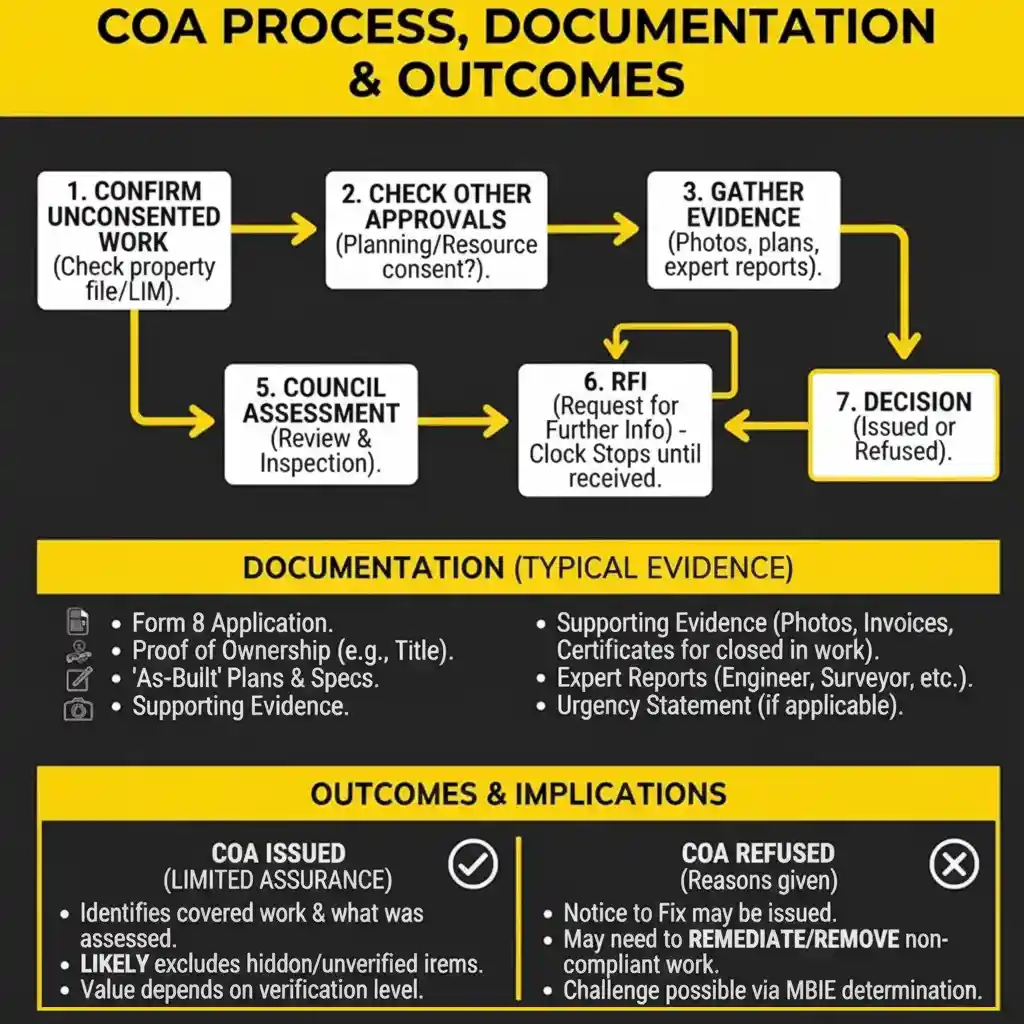
    1. 1Confirm what is unconsented: Check the council property file, LIM and consent records to identify exactly what work has no consent record.
    2. 2Check other approvals: Some situations may also involve planning, resource consent, change of use, compliance schedules or title constraints.
    3. 3Gather evidence: Collect photos, invoices, certificates, product information and any records showing what was built.
    4. 4Prepare technical documents: This may include as-built drawings, specifications, structural reports, drainage information, fire reports or other specialist evidence.
    5. 5Lodge Form 8: Submit the application with the required documents, explanations and fees.
    6. 6Council assesses the application: Council checks completeness, reviews evidence and may inspect the work where possible.
    7. 7Respond to RFIs: If council asks for more information, the processing clock can pause until the information is supplied.
    8. 8Receive the decision: Council may issue the CoA, often with qualifications, or refuse it and explain why.

    The CoA process, documentation and outcomes

    The process usually turns on evidence: what council can verify, what professionals can certify and what remains hidden or uncertain.

    Certificate of Acceptance process flowchart showing documentation, council assessment and possible outcomes

    Documents and evidence councils commonly expect

    Councils often need similar information to a building consent application, plus extra evidence proving what was actually built.

    • Certificate of Acceptance application, usually Form 8.
    • Proof of ownership or authority to apply.
    • Current lawfully established use and any change of use information.
    • Total floor area affected by the building work.
    • Names and details of people who carried out the work, where known.
    • Reasons why the CoA is required and why consent was not obtained.
    • As-built plans and specifications that match the completed work.
    • Photos, invoices, certificates, producer statements and specialist reports.
    • Compliance schedule information if specified systems are involved.
    • Fees, charges and levies that council requires for the application.

    Timeframes, costs and council outcomes

    IssueWhat to expect
    Processing timeCouncils commonly work to a 20-working-day timeframe once the application is complete. RFIs can pause processing while additional information is prepared.
    Council feesFees vary by council and complexity. You may also need to pay fees, charges or levies that would have applied if consent had been sought before the work was carried out.
    Professional costsAs-built drawings, engineering, fire, drainage, building surveying and other specialist evidence can become a major part of the total cost.
    If issuedThe CoA identifies the work covered and what was inspected or assessed. It may include qualifications or exclusions for hidden work.
    If refusedCouncil must explain why. A Notice to Fix may require remedial work so the work can comply with the Building Code.

    Practical tips before you apply

    Be specific about the work

    Describe what was built, when it was built, who did the work and what evidence exists.

    Match drawings to reality

    As-built plans should match the site, not what someone wishes had been built.

    Expect hidden-work questions

    Closed-in structural, waterproofing, drainage or fire elements usually need stronger evidence.

    Check planning issues early

    A CoA does not replace planning approvals, title checks, cross-lease approvals or resource consent.

    Possible outcomes

    If the CoA is issued

    The certificate identifies the work assessed and may record qualifications or exclusions for work council could not verify.

    If the CoA is refused

    Council must give reasons. You may need remedial work, removal, further assessment or a different compliance pathway.

    Quick glossary

    Building consent
    Permission issued before building work starts, unless the work is exempt or urgent work rules apply.
    CCC, or Code Compliance Certificate
    A certificate issued when council is satisfied that work complies with the issued building consent.
    CoA, or Certificate of Acceptance
    A council certificate providing limited confirmation of Building Code compliance for certain completed work.
    RFI, or Request for Further Information
    A council request for additional documents, evidence or clarification. Processing usually pauses until the response is supplied.
    Notice to Fix
    A formal notice requiring work to be fixed where council considers there has been a Building Act or Building Code issue.

    Certificate of Acceptance FAQs

    How much does a Certificate of Acceptance cost in NZ?

    Costs vary by council and complexity. Expect council processing fees plus professional fees for as-built plans, engineering reports and specialist assessments. Complex projects with closed-in work can cost several thousand dollars or more.

    How long does the COA process take?

    Councils commonly work to a 20-working-day processing timeframe once the application is complete. Requests for further information can pause the clock, so total timelines often extend beyond the base processing period.

    Does a COA mean my work is fully compliant?

    No. A COA gives limited assurance only for what council can reasonably assess after the work has been completed. Hidden or closed-in elements may be qualified or excluded.

    Can I get a COA for work done before 1 July 1992?

    Generally no. The Certificate of Acceptance pathway applies to certain building work carried out after building consents were introduced on 1 July 1992.

    Do I need an architect or engineer for a COA application?

    It depends on the work. Structural, fire, drainage, waterproofing or complex alterations often need professional assessment. Most COA applications benefit from clear as-built drawings and coordinated evidence.

    Can I sell my house without a COA for unconsented work?

    You may be able to sell, but unconsented work can affect buyer confidence, legal due diligence, lending, insurance and price negotiation. Get legal advice before relying on a sale strategy.

    What happens if my COA application is declined?

    Council must explain the reasons. You may need remedial work, removal, more evidence or another pathway. In some cases a Notice to Fix may be issued.

    Will I face fines or prosecution for unconsented work?

    A CoA does not prevent enforcement action. Councils often focus on compliance and safety, but notices, remedial requirements or enforcement action remain possible depending on the circumstances.

    Official references

    Where this guidance comes from

    This article is general guidance only. For formal requirements, check the Building Act, MBIE Building Performance guidance and your local council.

    Author

    Alejandro Hidalgo Uzqueda

    Founder, Director and NZ Registered Architect. NZRAB Registration No. 6195.

    Related pathways

    What to do after reading this guide

    If this article sounds similar to your situation, choose the next pathway based on the problem you are trying to solve.

    Need help applying this to your project?

    Turn the guide into a clear council pathway.

    Send the work description, photos, plans, LIM or council correspondence. We can help identify whether you need CoA support, RFI support, remedial documentation or another pathway.