
Direct answer
What is a building use classification?
For Building Act change-of-use purposes, every building or part of a building has a use under Schedule 2 of the Building (Specified Systems, Change the Use, and Earthquake-prone Buildings) Regulations 2005. These use groups include SH, SR, SA, SC, SD, CS, CL, CO, CM, WL, WM, WH, WF, IA and ID.
The Building (Forms) Regulations 2004 do not create these use groups. They prescribe forms such as Form 2 and Form 8, which ask for the current lawfully established use, occupant information and, where relevant, the previous or proposed use.
A Schedule 2 use is only one part of the assessment. The Building Code also uses classified uses under clause A1, and fire design uses risk groups under C/AS1 and C/AS2.
Important: one building can have different uses in different parts. For example, a shop with a residential apartment above it may be CM for the shop and SR for the apartment.
Field note
Why these terms are easy to confuse
New Zealand legislation and technical documents use similar words for different purposes. Schedule 2 describes the use of a building or part of a building for the change-of-use provisions. Clause A1 classifies buildings for Building Code purposes. C/AS1 and C/AS2 then use fire risk groups to establish a fire-safety pathway.
A code such as SH may appear in more than one system, but the meaning must always be checked against the document where it appears.
Three related systems - not one universal classification
The correct answer depends on the question being asked. Do not transfer a code from one system into another without checking its source.
1. Schedule 2 use groups
Statutory uses for all or parts of buildings. They are used mainly to decide whether sections 114 and 115 of the Building Act are triggered by a change of use.
2. A1 classified uses
Building Code categories such as Detached Dwelling, Multi-unit Dwelling, Community Service, Commercial, Industrial, Outbuilding and Ancillary.
3. Fire risk groups
Fire-design categories in C/AS1 and C/AS2, including SH, SM, SI, CA, WB, WS and VP. They determine the fire-safety requirements for activities and firecells.
How to read the diagrams
Illustrations only - assess the actual building use
These diagrams are simplified illustrations of Schedule 2 use groups under the Building (Specified Systems, Change the Use, and Earthquake-prone Buildings) Regulations 2005. They are not a substitute for assessing the actual use of a building under regulation 6 or determining the applicable Building Code classified use and fire-risk group.
Important: the same type of space can fall into a different category depending on its primary use, occupants, layout, cooking facilities, fire load, storage and relationship to other parts of the building.
Sleeping activities: residential building classifications
These are the most common classifications for homeowners. If you are dealing with a house, flat, granny flat, apartment or residential accommodation, start here.
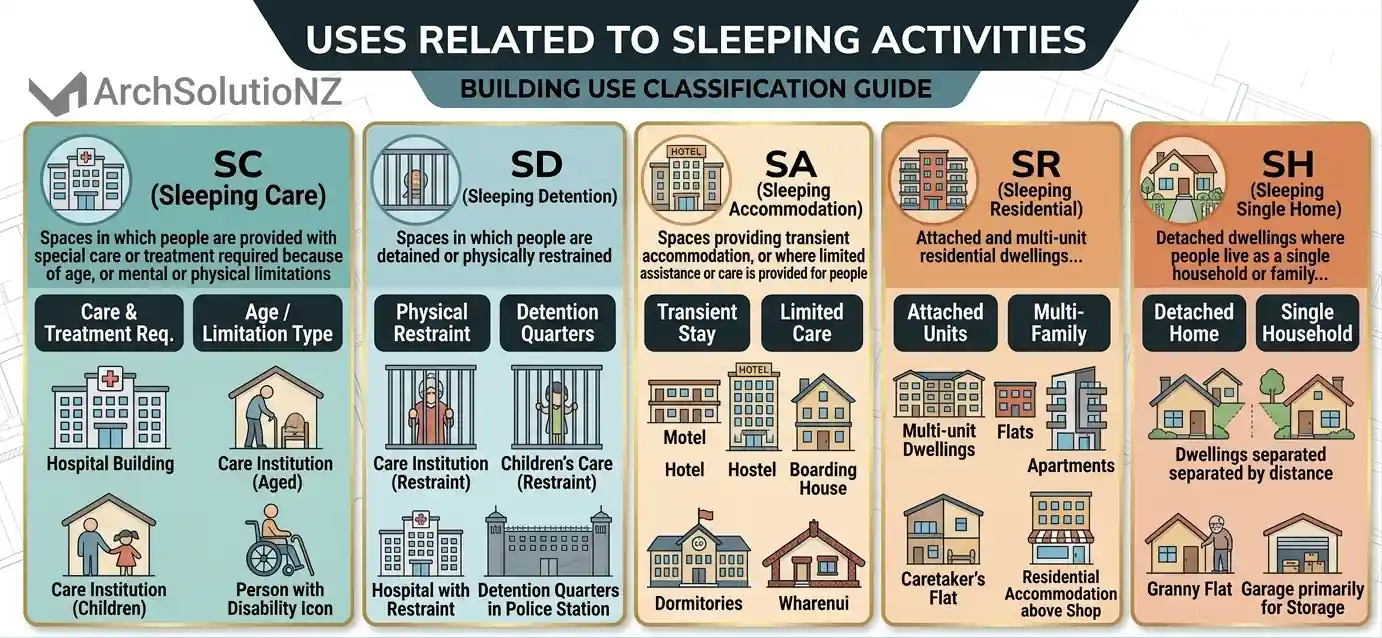
Sleeping Single Home
Detached dwellings where people live as one household or family. This may include an attached or associated family granny flat, and garages used for the occupants' vehicles, tools and garden equipment.
Examples: Standalone houses, ordinary family homes, family-occupied granny flats, attached residential garages.
Sleeping Residential
Attached or multi-unit residential accommodation, including household units attached to spaces with other uses.
Examples: Apartments, flats, attached townhouses, a residential flat above a shop, separate rented minor dwellings.
Sleeping Accommodation
Spaces providing transient accommodation or limited assistance or care.
Examples: Motels, hotels, hostels, boarding houses, dormitories, wharenui and halls used for sleeping.
Sleeping Care
Spaces where people are provided with special care or treatment because of age, mental or physical limitations.
Examples: Hospitals, rest homes, hospices and care institutions.
Sleeping Detention
Spaces where people are detained or physically restrained.
Examples: Prisons, secure hospitals and Police station detention areas.
Crowd activities
Crowd classifications apply where people gather, view, assemble, eat, drink, shop or attend events. The split often depends on occupant numbers, cooking facilities and the type of activity.
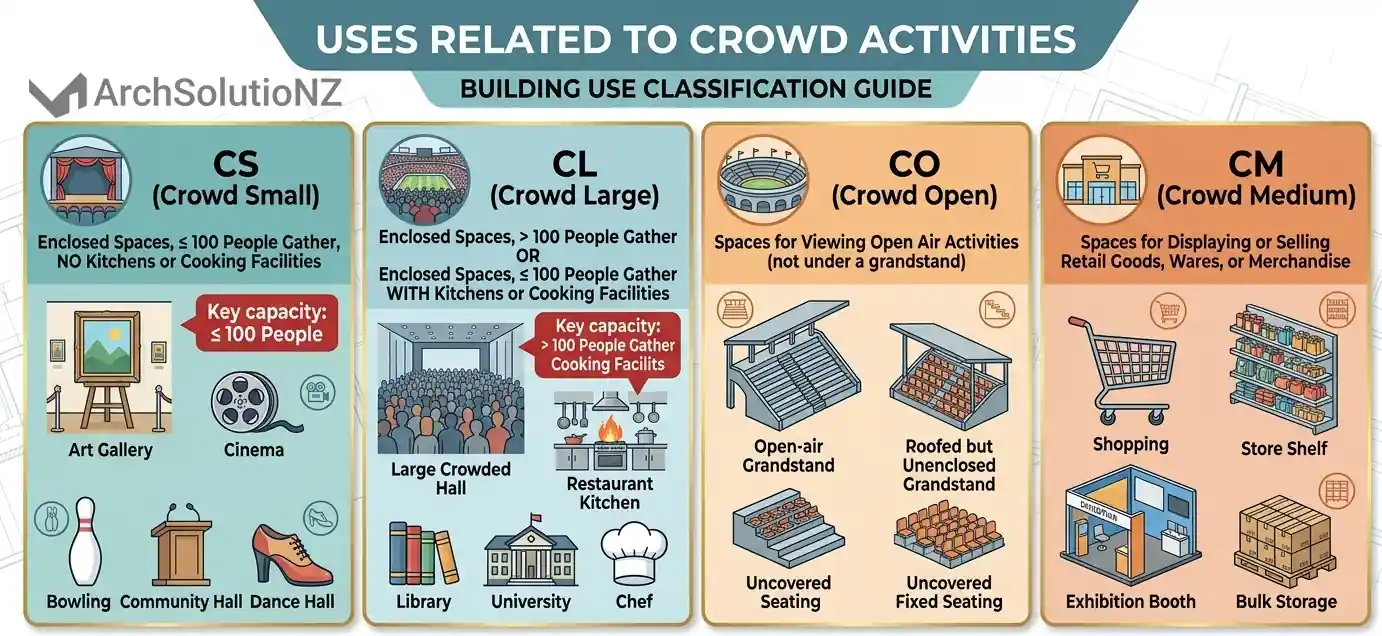
Crowd Small
Crowd spaces with 100 people or fewer, generally without cooking facilities.
Examples: Small halls, small churches, clubrooms and meeting spaces.
Crowd Large
Crowd spaces for more than 100 people or spaces with kitchens or cooking facilities.
Examples: Restaurants, cafes with commercial kitchens, large halls, theatres and assembly spaces.
Crowd Open
Spaces for viewing open-air activities.
Examples: Open grandstands, roofed but unenclosed grandstands and uncovered fixed seating.
Crowd Medium
Spaces for displaying or selling retail goods, wares or merchandise.
Examples: Retail shops, supermarkets, exhibition halls and stores with display or bulk retail storage.
Working, business and storage activities
Working classifications are split by fire load and fire growth rate. Many small commercial offices, shops and clinics sit in WL, but storage, manufacturing and flammable materials can move the classification into higher-risk categories.
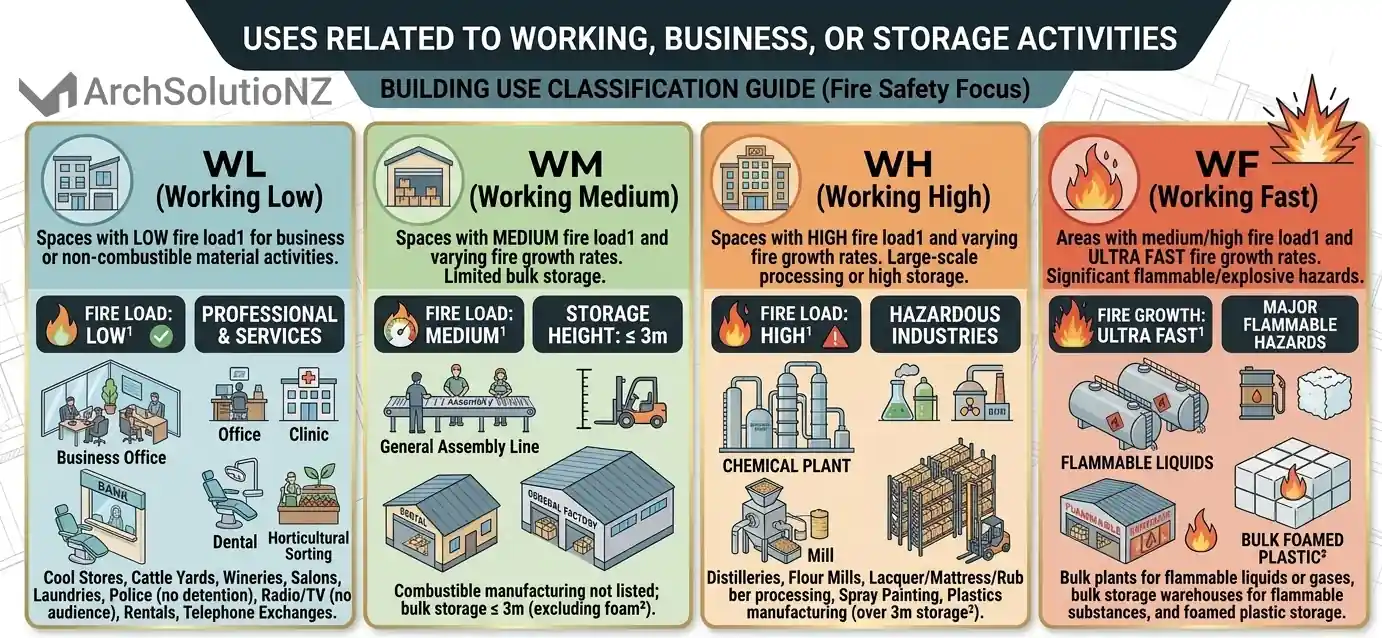
Working Low
Working, business or storage spaces with a low fire load.
Examples: Business offices, dental practices, hairdressers, beauty parlours, medical offices, cool stores, wineries and low fire-load storage.
Working Medium
Working, business or storage spaces with a medium fire load.
Examples: Manufacturing, processing or storage of combustible materials not classified as high or fast growth.
Working High
Working or storage spaces with a high fire load.
Examples: Chemical plants, distilleries, feed mills, flour mills, spray painting and high combustible storage.
Working Fast
Spaces with medium or high fire load and ultra-fast fire growth.
Examples: Bulk storage of flammable liquids, gases, explosive materials or foamed plastics.
Intermittent activities
Intermittent activity classifications cover support, circulation and service spaces that are not normally occupied continuously. Image caution: the lower-left examples in the IA panel of the illustration include working/business examples copied from the WL category. They should not be treated as IA examples. Use the written IA and ID descriptions below and assess the actual primary use.
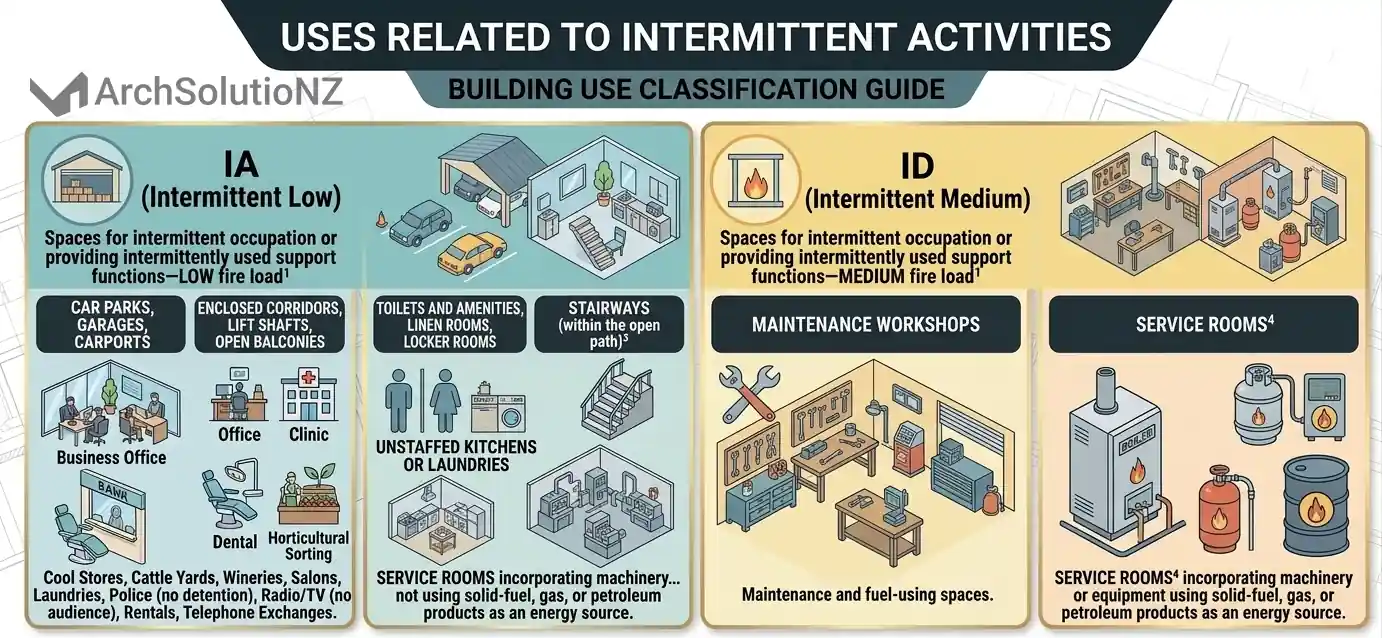
Intermittent Low
Support or circulation spaces with intermittent occupation and low fire load.
Examples: Car parks, detached garages, carports, corridors, toilets, stairs, lift shafts and locker rooms.
Intermittent Medium
Intermittently occupied service spaces with a medium fire load.
Examples: Maintenance workshops and service rooms with solid-fuel, gas or petroleum-fired equipment.
Where use information appears on Form 2 and Form 8
The forms do not replace the legal classification analysis. They require the applicant to describe the building's current lawfully established use, occupant information and any relevant change of use.
Form 2
Records the current lawfully established use and asks whether the building work will result in a change of use. If yes, the new use must be described.
Form 8
For a Certificate of Acceptance, records the current lawfully established use and requires the previous use to be stated if the use was changed by the building work.
Practical approach
State the actual use in plain English, identify the likely Schedule 2 use group, and separately assess the A1 classified use and C/AS risk group where relevant.
Quick reference for common homeowner projects
| Project or space | Likely classification |
|---|---|
| New family home | SH under Schedule 2; Detached Dwelling under A1; normally risk group SH. |
| Family granny flat occupied by the same family | Usually SH, provided the arrangement remains part of one family or household. |
| Detached self-contained dwelling for another household | May remain SH if it is a detached dwelling; SR is more likely where it is attached or part of a multi-unit building. Assess the actual arrangement. |
| Renovation or extension to an existing house | Usually retains the existing use, but building work may trigger alteration requirements under section 112. |
| Garage used by the household | Often SH when primarily associated with and used by the dwelling occupants; not automatically IA. |
| Detached garage, carport or parking structure | May be SH when associated with a dwelling, or IA where it is an intermittently occupied support or parking space. |
| Duplex or attached townhouses | Usually SR under Schedule 2; the fire risk group may be SH or SM depending on the configuration and escape routes. |
| Apartment above a shop | SR for the apartment and CM for the retail shop under Schedule 2. |
| Small home office | May remain part of SH where it is ancillary to the home; a separate primary office or business use may be WL. |
| Cafe or restaurant with cooking facilities | Usually CL under Schedule 2, with the applicable A1 and C/AS classifications assessed separately. |
| Retail shop | CM under Schedule 2, with the applicable A1 and C/AS classifications assessed separately. |
Change-of-use warning
A statutory change of use occurs only when both tests are satisfied:
- the building or part changes from one Schedule 2 use group to another; and
- the new use creates additional or more onerous Building Code requirements.
If the tests are met, the owner must notify the territorial authority under section 114 and must not change the use until the authority gives the written confirmation required by section 115. This is separate from deciding whether building consent is required for associated building work.
Example: converting a single home into attached or multi-unit residential accommodation may change SH to SR and can introduce more onerous requirements for fire separation, escape, sanitary facilities, structure or access.
Key definitions
- Schedule 2 use group
- The statutory use assigned to a building or part of a building under the 2005 Change-of-Use Regulations, such as SH, SR, SA, WL or IA.
- Classified use
- A Building Code classification under clause A1, such as Detached Dwelling, Multi-unit Dwelling, Commercial or Outbuilding.
- Fire risk group
- A fire-design category in C/AS1 or C/AS2 used to establish fire-safety requirements for activities and firecells.
- Current, lawfully established use
- The use that is lawfully established for the building at the relevant time. This is the information requested on forms such as Form 2 and Form 8.
- Firecell
- A space within a building that is separated from other spaces by fire-resisting construction as required by the applicable fire design.
- Fire load
- The combustible content and fire-growth potential relevant to classifying working, business and storage activities.
Building use classification FAQs
Are Schedule 2 use groups the same as A1 classified uses?
No. Schedule 2 uses are used mainly for the Building Act change-of-use provisions. A1 classified uses are Building Code categories. They often relate to each other, but they are not interchangeable.
Are fire risk groups the same as Schedule 2 use groups?
No. Fire risk groups are used by C/AS1 and C/AS2 to establish fire-safety requirements. Some codes overlap, such as SH, but the systems serve different purposes.
What is the use of an ordinary detached family home?
Usually SH under Schedule 2, Detached Dwelling under A1 and risk group SH under C/AS1, subject to the actual arrangement and use.
Is a detached rented granny flat automatically SR?
No. A detached self-contained dwelling may remain SH under Schedule 2. SR is more likely where the accommodation is attached or forms part of a multi-unit building. The physical arrangement and actual occupation must be assessed.
Is a garage always IA?
No. A garage associated with a dwelling and primarily used by its occupants may fall within SH. IA can apply to other intermittently occupied support, parking or service spaces.
Can one building have more than one Schedule 2 use?
Yes. Schedule 2 applies to buildings or parts of buildings. A shop and apartment in the same building may have different uses.
Does every change from one Schedule 2 code to another trigger section 114?
No. The new use must also create additional or more onerous Building Code requirements. Both parts of the statutory test must be satisfied.
Does changing use automatically require a building consent?
No. A change of use itself does not automatically require building consent, but building consent may be required for building work needed to achieve the required compliance.
What should be written on Form 8 for a Certificate of Acceptance?
Describe the current lawfully established use, occupant information and the previous use if the use was changed by the building work. Identify the relevant Schedule 2 use where appropriate.
What is a small home office?
A sole trader's ancillary home office may remain part of SH where the primary use remains residential and no additional users need to be considered. A separate or primary office use may be WL and should be assessed accordingly.
Official references
Where this guidance comes from
This article is general guidance only. The final assessment depends on the building's actual construction, layout, occupants, lawful history and proposed use. The applicable council requirements must also be checked.
- Building (Specified Systems, Change the Use, and Earthquake-prone Buildings) Regulations 2005 - Schedule 2 uses
- Building Act 2004 - sections 114 and 115
- Building Regulations 1992 - clause A1 classified uses
- Building (Forms) Regulations 2004 - Form 2
- MBIE: Change of use, alterations and extension of life
- MBIE C/AS1 - risk group SH
- MBIE C/AS2 - risk groups other than SH
- MBIE Determination 2024/013 - garages, SH and IA
- MBIE Determination 2019/005 - detached self-contained dwelling and SH
Author
Alejandro Hidalgo Uzqueda
Founder, Director and NZ Registered Architect. NZRAB Registration No. 6195. ArchSolutioNZ uses Schedule 2 use groups, A1 classified uses and C/AS fire risk groups as separate parts of its building consent, Certificate of Acceptance and council documentation assessments.
Related pathways
What to read next
If you are choosing a classification because of unconsented work, a granny flat, a dwelling conversion or a new business use, these pages connect the next step.